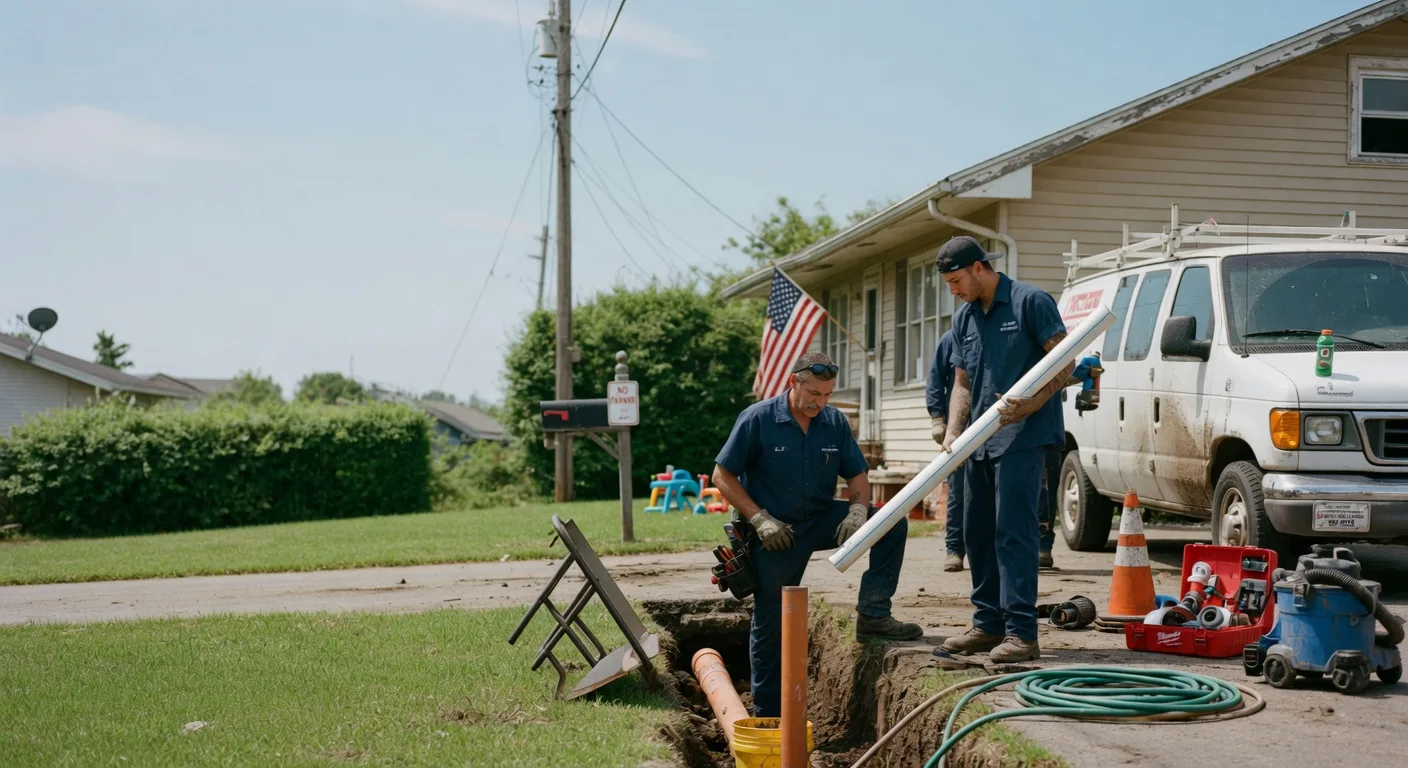
Why does the same drain keep clogging again just days after it was cleared?
A clog that returns within days almost always means one of two things. Either the first cleaning opened a path without removing the whole blockage, or the real cause was never touched. A cable machine punches a channel through the middle of a clog. That restores flow, but it can leave a ring of grease, scale, or packed debris clinging to the pipe wall, and that ring catches the next load of waste quickly. Underneath that sit the causes a cable cannot fix: roots growing in at a clay joint, a bellied section holding standing water, a cracked or offset joint catching paper, or rough scale in cast iron. Start by noting whether it is one fixture or several. A single kitchen or bathroom line that refills fast often needs hydro jetting, which scours the full width of the pipe wall rather than opening a hole through the center. A repeat clog in the main, or several fixtures slowing together, needs a camera inspection, because it shows the pipe's condition instead of just clearing it again. Chemical cleaner between visits usually makes things worse for the next tool. Expert Plumbers Co connects homeowners in Pleasant Valley, IA with an independent local plumber who can find out why the drain will not stay clear. Access to the line and how much of it must be opened up are what shape the repair.
Clearing a drain is not the end of the story, and knowing what to do afterward keeps the clog from coming back. Once a line is cleared, run hot water for a minute, then fill the sink and let it drain to check the flow. Use a drain strainer in showers and kitchen sinks to catch hair and food scraps before they enter the pipe. Keep a note of the date and what the plumber found, because a second clog in the same place within a few months is useful information. If hair is the cause, a monthly manual clean of the strainer and stopper helps more than any product. If the plumber mentions roots, a bellied pipe, or a cracked joint, ask what the options are and how quickly the problem is likely to return. Older homes often have cast iron or clay lines, where recurring trouble is more common than in newer plastic pipe.
Can a blocked vent stack cause slow drains even when there is no clog?
Yes. If a sink gurgles, a toilet burbles when another fixture drains, or water moves slowly with no clog anywhere, a blocked vent stack is a likely cause. The vent is the pipe that runs up through the roof. It lets air in behind the water so drains flow freely. When it is blocked, the drain pulls against a vacuum, and the water crawls out of the fixture.
Common causes are leaves, a nest or debris at the roof opening. Inside the wall, a vent can also collapse or fill with scale.
A vent problem often shows up on several fixtures at once. They drain, just slowly, and they gurgle. A clog usually stops one fixture. If every drain in the house is backing up, that is a main line job, not a vent.
Safe homeowner check: listen for gurgling, look at the roof opening from the ground, and run each fixture one at a time to see which ones act up. Do not climb onto the roof yourself.
Stop running water and call now if sewer odor is strong indoors, or a toilet or floor drain is bubbling up.
A cable machine run down from the roof opening clears most vent blockages. If it keeps coming back, a camera inspection shows whether the pipe is damaged. Cost depends on roof access and how far the blockage sits.
Expert Plumbers Co is a referral service. Call (380) 262-9173 and we will connect you with a plumber serving Pleasant Valley, IA for Drain Cleaning.
Several things can make a vent problem worse or confuse the diagnosis. In cold climates, frost can close the roof opening as moisture freezes around the rim, so symptoms appear in winter and ease in spring. A common mistake is treating the gurgle with repeated plunging or drain chemicals, which does not touch the real cause and can leave caustic liquid in the trap. Another sign it is getting worse is a toilet that fills slowly after flushing or a trap that loses its water seal, because that lets sewer gas into the room. Older homes often have vents routed through cramped walls with long horizontal runs where debris collects, while newer homes may use air admittance valves under sinks that can wear out and stick. When you call, mention which fixtures gurgle and in what order, since that tells the plumber which branch to follow first.
Can my downspouts or sump pump cause a sewage backup?
Every drain is gurgling and dirty water comes up the basement floor drain, but only when it rains. That is not one slow sink. Storm water is a prime suspect.
In older housing stock, gutters, a yard drain or a sump pump discharge were sometimes plumbed straight into the sanitary sewer. In a storm, all that extra water floods the house lateral and the municipal main. The pipe runs full, so sewage is pushed back up the lowest opening: a floor drain, a basement shower, a laundry standpipe.
Many jurisdictions now prohibit this. Disconnecting it is often a permit or code matter.
Safe homeowner check: walk the outside of the house. See where each downspout ends. Does it spill onto the ground, or vanish into a pipe in the soil? Does the sump pump discharge run out to daylight, away from the foundation, or into a pipe tied to the house drain? Look only. Do not dig.
Stop running water and call now if more than one fixture is backing up, if sewage is rising, or if it is reaching the floor. A single slow sink is a different job, and a cable machine usually handles it. A storm-driven backup is not a clog, so cabling will not cure it.
A plumber finds the connection with a camera inspection, which shows a tie-in on the pipe, or a dye test, where colored water poured into a downspout or sump shows up in the sewer. What the work involves depends on access, the materials, how much has to be opened up, and any permit requirement.
Expert Plumbers Co is a referral service. We refer homeowners in Pleasant Valley, IA to an independent local plumber for Drain Cleaning and Emergency Drain Cleaning. Call (380) 262-9173.
Once the connection is found, the usual fix redirects the storm water instead of changing the sewer. Downspouts can be extended to discharge onto the ground well away from the foundation, with the soil graded to carry water off. A sump discharge should run outdoors to daylight or to a drainage point that local code accepts.
A common mistake is capping the old pipe at the wall and leaving the buried tie-in open to the sewer. An open stub can still admit soil, roots and water. Ask the plumber to confirm the old connection is sealed at the sewer end, not just hidden from view.
Sump pumps run hardest during the very storms that load the sewer, so a pump that cycles constantly is worth mentioning on the call. After the change, watch the next heavy rain. The floor drain should stay quiet. If it still gurgles, the cause may be the street main or a damaged lateral, not the tie-in.
Can a drain cable or hydro jetting damage old pipes like cast iron, clay or thin-wall pipe?
Yes, it can, and a good plumber knows that before the machine is switched on. Old pipe is not equally fragile everywhere, and the choice of tool depends on what the pipe is made of and what shape it is in.
Cable machines spin a cutting head against the pipe wall. In sound pipe that is fine. In clay with offset joints, the head can catch on a lip and snag. In cast iron with heavy scale, a cutting head can knock loose flakes, and in a pipe already thinned by corrosion it can punch through. Thin-wall plastic or older Orangeburg-type fiber pipe can be gouged or deformed.
Hydro jetting pushes water at high pressure through a nozzle. On solid pipe it cleans the walls better than a cable. On a cracked clay pipe, a corroded cast iron stack, or a joint that has already shifted, that pressure can widen the damage or send water out into the soil.
So how does the plumber decide? Usually from several clues:
The age and material of the house and the pipe, which tells the plumber what to expect.
Past history, such as repeated roots, earlier repairs, or a line that has never been inspected.
How the cable behaves. A head that bounces, stops at the same distance, or comes back with pipe chips or rust flakes suggests the pipe itself is damaged.
A camera look first. This is the most direct answer. If the line is fragile or offset, the plumber can choose a gentler head, lower pressure, or no jetting at all.
If you suspect old pipe, say so on the phone. Tell the plumber the age of the house and the pipe material if you know it. Ask whether the tool will be matched to the pipe, and whether a camera look comes first.
Sometimes the honest answer is that a quick clearing is worth the risk to get water moving, with a plan to inspect afterward. Sometimes it is not. Either way, the decision should be explained to you before the work starts, not after.
If you need a drain cleared in Pleasant Valley, IA, Expert Plumbers Co can connect you with an independent local plumber at (380) 262-9173.
My child flushed a toy, or something solid went down the toilet. What should I do, and what should I not do?
Stop first. Do not flush again, even if the water looks like it is going down. Each flush pushes the object further along, and it can lodge in the toilet's trap or in the drain behind it. Tell everyone in the house not to use that toilet.
If the toilet still drains but the bowl is high, leave it. If it is rising toward the rim, lift the tank lid and push the flapper down, or turn the shutoff valve behind the toilet clockwise to stop more water entering.
What is safe to try: if you can see the object near the bowl opening and it is not breakable, put on gloves and pick it up. Use a wet vac or a closet auger only if you are comfortable with it, because an auger can also shove a hard toy deeper. Be gentle with a plunger. A plunger can free a soft item, such as paper or cloth, but it often wedges a solid piece tighter.
What not to do: do not use chemical drain cleaners, which do nothing to a solid object and make the water dangerous to handle. Do not keep plunging hard, and do not push a coat hanger down the drain, which can scratch the porcelain or drive the object into the pipe wall.
If the object has already gone and the toilet seems normal, watch for slow drains, gurgling or other fixtures backing up over the next few days. A small toy can catch in a bend and collect paper behind it. If the toilet becomes slow, or the same one keeps clogging, the object is probably still in the line.
In that case the plumber may pull the toilet off its seat to retrieve it from underneath, which is often cleaner than cabling into a pipe. If the item is in the drain behind the toilet, a camera can find it and the plumber can retrieve it or push it clear. Cost depends on where it lodged, whether the toilet must be removed, and how much access is needed.
Expert Plumbers Co can connect you with an independent plumber in Pleasant Valley, IA for this: call (380) 262-9173.